Run an EasyVVUQ campaign to analyze the sensitivity for the Ishigami function using MCsampler
This is done with the MCsampler that uses the Saltelli algorithm [1] to compute the Sobol indices. If n_mc_samples is the number of Monte Carlo samples specified in the MCSampler, the Saltelli algorithm uses n_mc_samples * (d + 2) samples to compute the Sobol indices, where d is the number of random input variables. Bootstrapping is used to compute confidence intervals on the Sobol index estimates.
[1] A. Saltelli, Making best use of model evaluations to compute sensitivity indices, Computer Physics Communications, 2002.
[1]:
# Run an EasyVVUQ campaign to analyze tgohe sensitivity for the Ishigami function
# This is done with SC.
%matplotlib inline
import os
import easyvvuq as uq
import chaospy as cp
import pickle
import numpy as np
import matplotlib.pylab as plt
import time
import pandas as pd
from collections import OrderedDict
[2]:
np.__version__
[2]:
'1.26.4'
[3]:
# Define the Ishigami function
def ishigamiSA(a,b):
    '''Exact sensitivity indices of the Ishigami function for given a and b.
    From https://openturns.github.io/openturns/master/examples/meta_modeling/chaos_ishigami.html
    '''
    var = 1.0/2 + a**2/8 + b*np.pi**4/5 + b**2*np.pi**8/18
    S1 = (1.0/2 + b*np.pi**4/5+b**2*np.pi**8/50)/var
    S2 = (a**2/8)/var
    S3 = 0
    S13 = b**2*np.pi**8/2*(1.0/9-1.0/25)/var
    exact = {
            'expectation' : a/2,
            'variance' : var,
            'S1' : (1.0/2 + b*np.pi**4/5+b**2*np.pi**8.0/50)/var,
            'S2' : (a**2/8)/var,
            'S3' : 0,
            'S12' : 0,
            'S23' : 0,
            'S13' : S13,
            'S123' : 0,
            'ST1' : S1 + S13,
            'ST2' : S2,
            'ST3' : S3 + S13
            }
    return exact

Ishigami_a = 7.0
Ishigami_b = 0.1
exact = ishigamiSA(Ishigami_a, Ishigami_b)
[4]:
# define a model to run the Ishigami code directly from python, expecting a dictionary and returning a dictionary
def run_ishigami_model(input):
    import Ishigami
    qois = ["Ishigami"]
    del input['out_file']
    return {qois[0]: Ishigami.evaluate(**input)}
[5]:
# Define parameter space
def define_params():
    return {
        "x1":       {"type": "float",   "min": -np.pi,     "max": np.pi,      "default": 0.0},
        "x2":       {"type": "float",   "min": -np.pi,     "max": np.pi,      "default": 0.0},
        "x3":       {"type": "float",   "min": -np.pi,     "max": np.pi,      "default": 0.0},
        "a":        {"type": "float",   "min": Ishigami_a, "max": Ishigami_a, "default": Ishigami_a},
        "b":        {"type": "float",   "min": Ishigami_b, "max": Ishigami_b, "default": Ishigami_b},
        "out_file": {"type": "string",  "default": "output.csv"}
    }
[6]:
# Define parameter space
def define_vary():
    return {
        "x1":   cp.Uniform(-np.pi, np.pi),
        "x2":   cp.Uniform(-np.pi, np.pi),
        "x3":   cp.Uniform(-np.pi, np.pi)
    }
[7]:
# Set up and run a campaign
def run_campaign(n_mc_samples, use_files=False):

    times = np.zeros(7)

    time_start = time.time()
    time_start_whole = time_start

    work_dir = '/tmp'

    # Set up a fresh campaign called "Ishigami_sc."
    my_campaign = uq.Campaign(name='Ishigami_mc.', work_dir=work_dir)

    # Create an encoder and decoder for SC test app
    if use_files:
        encoder = uq.encoders.GenericEncoder(template_fname='Ishigami.template',
                                             delimiter='$',
                                             target_filename='Ishigami_in.json')

        decoder = uq.decoders.SimpleCSV(target_filename="output.csv",
                                        output_columns=["Ishigami"])

        execute = uq.actions.ExecuteLocal('python3 %s/Ishigami.py Ishigami_in.json' % (os.getcwd()))

        actions = uq.actions.Actions(uq.actions.CreateRunDirectory(work_dir),
                          uq.actions.Encode(encoder), execute, uq.actions.Decode(decoder))
    else:
        actions = uq.actions.Actions(uq.actions.ExecutePython(run_ishigami_model))

    # Add the app (automatically set as current app)
    my_campaign.add_app(name="Ishigami", params=define_params(), actions=actions)

    # Create the sampler
    time_end = time.time()
    times[1] = time_end-time_start
    print('Time for phase 1 = %.3f' % (times[1]))

    time_start = time.time()
    # Associate a sampler with the campaign
    # Latin HyperCube
    sampler = uq.sampling.MCSampler(vary=define_vary(), n_mc_samples=n_mc_samples, rule='sobol')
    # QMC method with Sobol sequence
    #sampler = uq.sampling.QMCSampler(vary=define_vary(), n_mc_samples=n_mc_samples)
    my_campaign.set_sampler(sampler)

    # Will draw all (of the finite set of samples)
    my_campaign.draw_samples()
    print('Number of samples = %s' % my_campaign.get_active_sampler().count)

    time_end = time.time()
    times[2] = time_end-time_start
    print('Time for phase 2 = %.3f' % (times[2]))

    time_start = time.time()
    # Run the cases
    my_campaign.execute(sequential=True).collate(progress_bar=True)

    time_end = time.time()
    times[3] = time_end-time_start
    print('Time for phase 3 = %.3f' % (times[3]))

    time_start = time.time()
    # Get the results
    results_df = my_campaign.get_collation_result()

    time_end = time.time()
    times[4] = time_end-time_start
    print('Time for phase 4 = %.3f' % (times[4]))

    time_start = time.time()
    # Post-processing analysis
    results = my_campaign.analyse(qoi_cols=["Ishigami"])

    time_end = time.time()
    times[5] = time_end-time_start
    print('Time for phase 5 = %.3f' % (times[5]))

    time_start = time.time()
    # Save the results
    #pickle.dump(results, open('Ishigami_results.pickle','bw'))
    time_end = time.time()
    times[6] = time_end-time_start
    print('Time for phase 6 = %.3f' % (times[6]))
#
    times[0] = time_end - time_start_whole

    return results_df, results, times, n_mc_samples, my_campaign.get_active_sampler().count
[8]:
# Calculate the results for a range of MC points

d = len(define_vary())

R = {}
for n_mc_samples in [100, 500, 1000, 2000, 5000, 8000, 10000]:
    # the true number of MC samples used by Saltelli's algorithm
    n = n_mc_samples * (d + 2)
    R[n] = {}
    (R[n]['results_df'],
     R[n]['results'],
     R[n]['times'],
     R[n]['order'],
     R[n]['number_of_samples']) = run_campaign(n_mc_samples=n_mc_samples, use_files=False)
Time for phase 1 = 0.045
Number of samples = 500
Time for phase 2 = 0.120
100%|███████████████████████████████████████| 500/500 [00:00<00:00, 6392.88it/s]
Time for phase 3 = 0.110
Time for phase 4 = 0.009
Vectorized bootstrapping
Vectorized bootstrapping
Vectorized bootstrapping
Time for phase 5 = 0.152
Time for phase 6 = 0.000
Time for phase 1 = 0.007
Number of samples = 2500
Time for phase 2 = 0.606
100%|█████████████████████████████████████| 2500/2500 [00:00<00:00, 6669.05it/s]
Time for phase 3 = 0.421
Time for phase 4 = 0.028
Vectorized bootstrapping
Vectorized bootstrapping
Vectorized bootstrapping
Time for phase 5 = 0.806
Time for phase 6 = 0.000
Time for phase 1 = 0.006
Number of samples = 5000
Time for phase 2 = 1.144
100%|█████████████████████████████████████| 5000/5000 [00:00<00:00, 6494.61it/s]
Time for phase 3 = 0.859
Time for phase 4 = 0.115
Vectorized bootstrapping
Vectorized bootstrapping
Vectorized bootstrapping
Time for phase 5 = 1.430
Time for phase 6 = 0.000
Time for phase 1 = 0.006
Number of samples = 10000
Time for phase 2 = 2.276
100%|███████████████████████████████████| 10000/10000 [00:01<00:00, 6183.05it/s]
Time for phase 3 = 1.861
Time for phase 4 = 0.173
Vectorized bootstrapping
Vectorized bootstrapping
Vectorized bootstrapping
Time for phase 5 = 3.428
Time for phase 6 = 0.000
Time for phase 1 = 0.028
Number of samples = 25000
Time for phase 2 = 6.495
100%|███████████████████████████████████| 25000/25000 [00:04<00:00, 5798.93it/s]
Time for phase 3 = 4.972
Time for phase 4 = 0.484
Vectorized bootstrapping
Vectorized bootstrapping
Vectorized bootstrapping
Time for phase 5 = 8.124
Time for phase 6 = 0.000
Time for phase 1 = 0.018
Number of samples = 40000
Time for phase 2 = 9.597
100%|███████████████████████████████████| 40000/40000 [00:07<00:00, 5474.42it/s]
Time for phase 3 = 8.179
Time for phase 4 = 0.718
Vectorized bootstrapping
Vectorized bootstrapping
Vectorized bootstrapping
Time for phase 5 = 14.460
Time for phase 6 = 0.000
Time for phase 1 = 0.018
Number of samples = 50000
Time for phase 2 = 11.891
100%|███████████████████████████████████| 50000/50000 [00:09<00:00, 5116.26it/s]
Time for phase 3 = 11.066
Time for phase 4 = 0.920
Vectorized bootstrapping
Vectorized bootstrapping
Vectorized bootstrapping
Time for phase 5 = 17.451
Time for phase 6 = 0.000
[9]:
# produce a table of the time taken for various phases
# the phases are:
#   1: creation of campaign
#   2: creation of samples
#   3: running the cases
#   4: calculation of statistics including Sobols
#   5: returning of analysed results
#   6: saving campaign and pickled results

Timings = pd.DataFrame(np.array([R[r]['times'] for r in list(R.keys())]),
             columns=['Total', 'Phase 1', 'Phase 2', 'Phase 3', 'Phase 4', 'Phase 5', 'Phase 6'],
             index=[R[r]['order'] for r in list(R.keys())])
# Timings.to_csv(open('Timings.csv', 'w'))
display(Timings)
| Total | Phase 1 | Phase 2 | Phase 3 | Phase 4 | Phase 5 | Phase 6 | |
|---|---|---|---|---|---|---|---|
| 100 | 0.435259 | 0.044919 | 0.119578 | 0.109621 | 0.008567 | 0.152388 | 0.000000e+00 |
| 500 | 1.868456 | 0.007364 | 0.606182 | 0.420718 | 0.027718 | 0.806315 | 0.000000e+00 |
| 1000 | 3.553871 | 0.006349 | 1.144071 | 0.859180 | 0.114510 | 1.429628 | 0.000000e+00 |
| 2000 | 7.744114 | 0.005847 | 2.275557 | 1.861108 | 0.173382 | 3.428053 | 9.536743e-07 |
| 5000 | 20.103047 | 0.027934 | 6.494843 | 4.971630 | 0.484398 | 8.123843 | 0.000000e+00 |
| 8000 | 32.972410 | 0.017668 | 9.597153 | 8.179419 | 0.717565 | 14.460245 | 0.000000e+00 |
| 10000 | 41.345705 | 0.017865 | 11.890518 | 11.065725 | 0.919810 | 17.451130 | 0.000000e+00 |
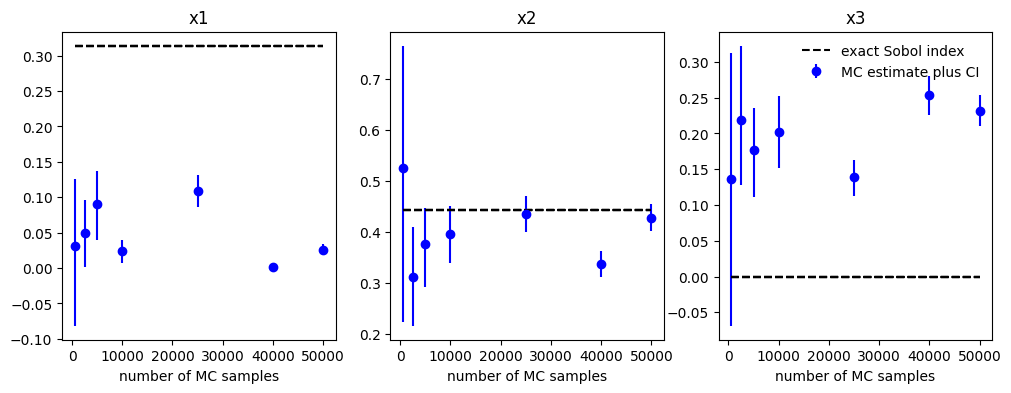
[10]:
# plot the Sobol indices with bootstrap error bars versus the exact values of the (first-order) Sobol indices

sobol_first_exact = {'x1': exact['S1'], 'x2': exact['S2'], 'x3': exact['S3']}

N = [R[r]['number_of_samples'] for r in list(R.keys())]

fig = plt.figure(figsize=[12,4])

for idx, x in enumerate(sobol_first_exact.keys()):
    ax = fig.add_subplot(1, d, idx + 1, xlabel='number of MC samples', title=x)
    for n in N:
        sobol = R[n]['results'].sobols_first('Ishigami')[x]
        sobol_CI = R[n]['results']._get_sobols_first_conf('Ishigami', x)
        yerr = [sobol - sobol_CI[0], sobol_CI[1] - sobol]
        ax.errorbar(n, sobol, yerr=yerr, fmt='bo', label='MC estimate plus CI')
        ax.plot(N, sobol_first_exact[x] * np.ones(len(N)), '--k', label='exact Sobol index')

# avoid repeated legends
handles, labels = plt.gca().get_legend_handles_labels()
by_label = OrderedDict(zip(labels, handles))
plt.legend(by_label.values(), by_label.keys(), frameon=False)
plt.savefig('sobols_CI.png')
[11]:
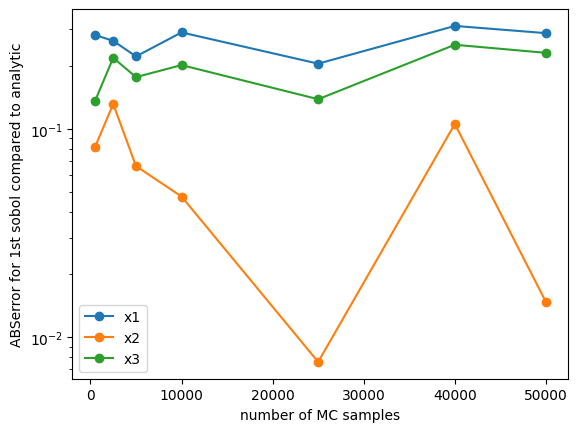
# plot the convergence of the first sobol to that of the highest order

sobol_first_exact = {'x1': exact['S1'], 'x2': exact['S2'], 'x3': exact['S3']}

N = [R[r]['number_of_samples'] for r in list(R.keys())]
plt.figure()
for v in list(R[N[0]]['results'].sobols_first('Ishigami').keys()):
    plt.semilogy([n for n in N],
                 [np.abs(R[n]['results'].sobols_first('Ishigami')[v] - sobol_first_exact[v]) for n in N],
                 'o-',
                 label=v)
plt.xlabel('number of MC samples')
plt.ylabel('ABSerror for 1st sobol compared to analytic')
plt.legend(loc=0)
[11]:
<matplotlib.legend.Legend at 0x3365e2b70>
[ ]: